
[]()
I got a lot of messages after [my post yesterday.]()
Most of them were some version of:
* “Will AI disrupt X?”
* “Will AI replace Y?”
* “What about Z?”
I think there’s a better way to answer all of those.
Instead of debating each thing individually, just walk through your day in an AI-optimized world a few years from now.
That will tell you what actually gets replaced.
You wake up.
You don’t open a fitness app anymore.
You open your AI.
“I’ve got 45 minutes. What’s my workout?”
It already knows your goals, your history, how you slept, what you did yesterday.
It builds the workout. Adjusts in real time. Coaches you through it.
No app. No subscription. No switching.
Then your day starts.
You don’t check the markets across multiple apps.
Your AI already knows you care about that.
At 9:00 AM, it gives you a clean, 2-minute update.
What matters. What changed. What to pay attention to.
Nothing extra.
Then money.
You don’t have periodic calls with a financial advisor anymore.
There’s no “check-in.”
Your financial life is running 24/7 in the background.
As you earn, spend, invest, plan, it’s constantly optimizing.
Taxes. Allocations. Cash flow. Long-term planning.
All happening in real time.
Then your calendar.
You’re not managing it.
“Find 30 minutes next week to meet John.”
It coordinates everything. Schedules it. Adjusts automatically if something changes.
No back-and-forth. No email threads.
Then groceries.
You don’t make a list. You don’t open an app.
“Restock what we’re low on this week. Keep it healthy.”
It already knows what you eat, what you ran out of, what you didn’t use last time.
Orders it. Times delivery. Done.
Then lunch.
Today you might open Uber Eats and browse.
In an AI world, you just say:
“I want a salad from Honest Greens in 30 minutes.”
Done.
It figures out how to order it, whether that’s through Uber Eats or something else.
You never see the interface.
Same with getting around.
You don’t open Uber.
“I need to be at this address at 3:00.”
Handled.
Then communication.
You’re not checking email, iMessage, Slack.
Your AI just tells you what matters.
“Your sister messaged you.”
It shows you the message, drafts a reply in your voice, you hit send.
That’s it.
Music.
You don’t open Spotify.
“I’m reading for 30 minutes. Play something light.”
It handles it.
Housing.
You’re not scrolling listings.
You don’t open Zillow.
“Show me homes near my kid’s school under $1.5M with a 3-car garage.”
It filters everything instantly. Shows you the best options. Books tours.
Education.
Your kid doesn’t sit in a classroom where one teacher is teaching to the median of 30 students.
They have a personalized system.
It adapts in real time to how they learn, what they struggle with, how fast they move.
Every lesson is optimized for them.
Travel.
You don’t open ten tabs.
“Plan me a 3-day trip. Good weather. Great food. Minimal hassle.”
It builds it. Books it. Adjusts it.
Customer support.
You don’t wait on hold.
Your AI handles the issue, gets the refund, resolves it.
You just get the result.
* * *
If you step back, the pattern is obvious.
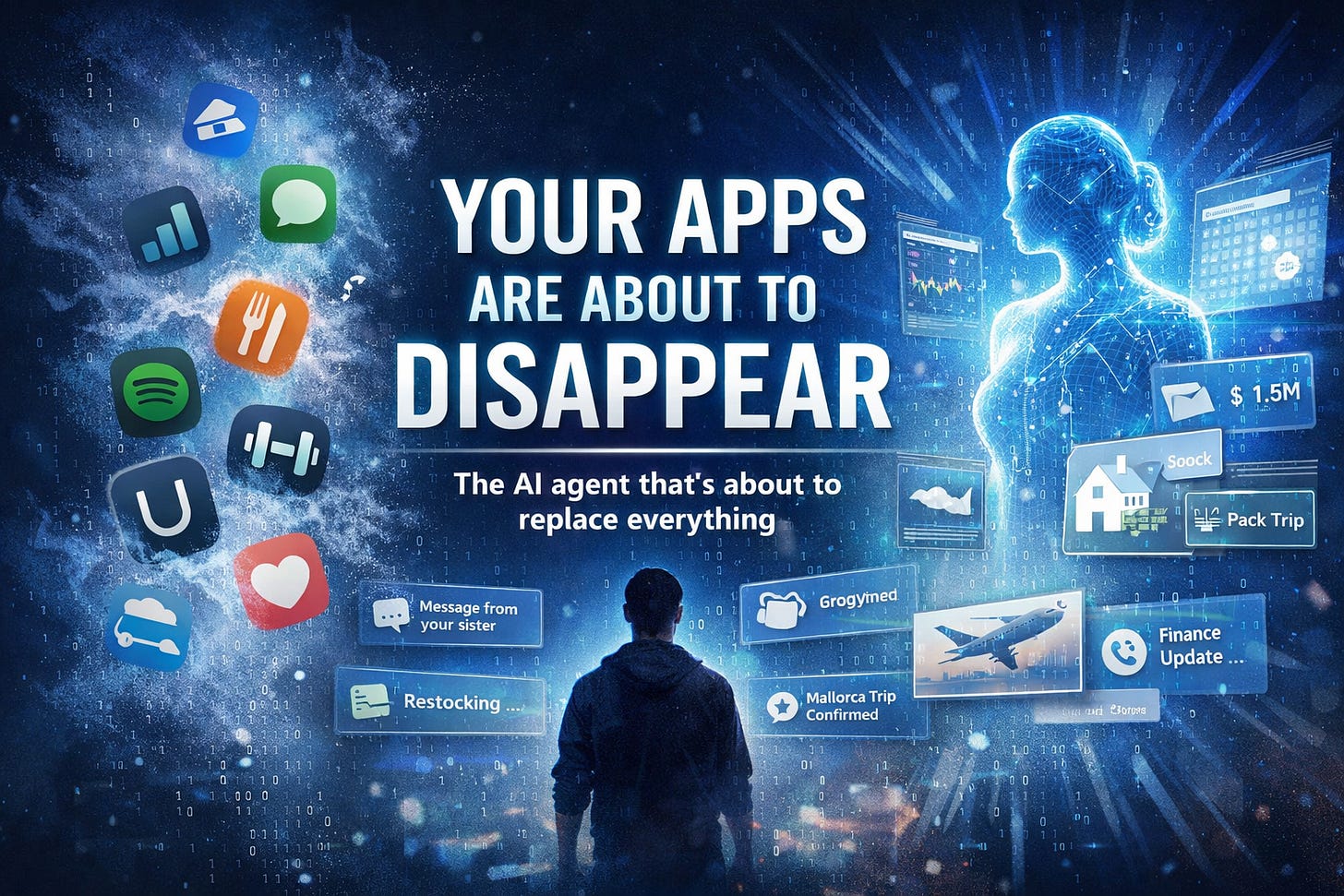
Every one of these used to be a separate app, a separate website, a separate interface.
That layer disappears.
Not because the services go away.
But because you never interact with them directly again.
Everything flows through one layer.
Your AI.
* * *
So when people ask:
“Will AI replace X?”
That’s not the real question.
The real question is:
**Does this exist in a world where everything runs through an AI agent?**
Because if it requires someone to:
* Open an app
* Visit a website
* Search manually
* Compare options
* Call a human
That entire behavior is going away.
* * *
The takeaway is simple.
Everything moves inside your AI agent’s platform.
Everything.
And if you understand that, you stop trying to protect the old layer.
You start building for the one that replaces it.
Most people aren’t there yet.
But that’s where this is going.