
I'm a recovering entrepreneur. I built a company for 18 years, sold it in 2025, and now spend my time figuring out what's next. Here's how I got here.
I was born in New York City in 1984 and grew up in White Plains. My dad commuted into the city as a product manager at a large corporation. My mom, who was Canadian and had moved to the US to be with my dad, ran our home with me and my younger sister.

When I was around two, my dad was promoted to General Manager of the Canadian OTC division of Sterling Drug. We moved to Aurora, Ontario, about 30 minutes from my mom's parents. A year and a half in, my dad got into a fight with his boss over how OTC products should be marketed differently from prescription drugs. They couldn't resolve it. He left the company with a generous severance package and no plan. We moved back to New York.
A few years later, a close friend of his who'd spent the previous year traveling America looking for somewhere to raise his family landed in Bellingham, Washington, a small city in the Pacific Northwest, north of Seattle, almost to the Canadian border. My parents flew out on a fact-finding mission. They liked what they saw. They sold off all their New York properties and decided to make the move out west an adventure.
The plan was plane, then overnight train, then RV. The train ahead of ours derailed somewhere in the middle of America, and our train sat in a corn field for two days while crews cleared the wreckage. I was eight. Coloring books and a bag of toys can only go so far. Once we got to Salt Lake City and into the RV, my parents drove us through the Grand Canyon, over the Rocky Mountain passes, under the California Redwoods, sleeping in KOA campgrounds that showed movies and served popcorn in the evenings, and finally up to Bellingham. They never moved again.
My mom's father, Ernie, had spent his entire career working for a stable national bank. The way my parents had just done it, walking away from a corporate job in Canada, selling everything in New York, and starting over with no plan in a town they'd visited once, was incomprehensible to him. My grandmother didn't tell my mom how worried he'd been until two years after the move, when it became clear it was actually working. I grew up inside the version of the world my parents had built. He grew up inside the one he was watching his daughter leave. That contrast was probably the first time I understood there were two ways to do this, and only one of them looked like ours.
My dad and two of his friends had bought a struggling business in Bellingham called Brentley, later renamed Brenthaven, a local maker of high-end backpacks, duffels, and travel gear. One of the partners, Richard Pelo, had a young son named Matt. Eighteen years later, Matt and I would start Tatango together.
After my dad sold his stake to Richard, he kept going. He and my mom built three different homes over six years, my dad doing most of the construction himself, teaching himself the trade as he went and only hiring contractors when a job was out of his depth. He bought a student apartment complex near Western Washington University, expanded it twice over the following decades into a portfolio of three buildings and 128 units, and was still stomping down garbage in the dumpsters himself to save the volume fees. He pivoted a struggling local bag company called Brentley's into a laptop case business that sold 90% of its product to Japanese companies. He bought a chemical sprays company out of Tacoma for $50K and sold it three years later for double. He and my mom patented a kitchen gadget that pressed rice into a little dome shape so it looked nice on the plate.
My mom enrolled in culinary school not to work at a restaurant but because she loved food, and graduated second in her class. She catered for the University's Friday-night faculty events, built a gourmet gift basket business called Washington Gourmet Gifts, and ran a side business selling patented rice molds she'd discovered in Chile.
My dad never slowed down. He drove from London to Ulaanbaatar in the Mongolian Rally in a car running under 1000cc and finished 7th. He sailed across the Atlantic on a flat racing sled with eight other people, eating freeze-dried food and taking four-hour shifts in an open cockpit for 17 days. He nearly drowned river rafting in Ecuador. He drove Route 66 with his best friend Barry. My mom, meanwhile, ran a Macadamia farm in Hawaii for a year. Most of this happened in their fifties and sixties. They were the loudest argument I'd ever seen for not waiting until later to do the things you actually want to do.
I didn't grow up watching my parents work nine-to-fives for someone else. I grew up inside a constant tornado of new businesses, new ideas, and new passions. Some friends didn't even know what their parents did for a living. I knew everything about ours.
That world wasn't background for me. It was the foreground.
It rubbed off fast.
Elementary school
My first venture, with help from my parents, was buying Airheads in bulk at Costco and selling them at school for two or three times what I'd paid. I had a Key Bank kids' account called Dino Savers, and I'd write checks from it to buy the inventory. The economics were beautiful. The school administration was less impressed. On the last day before they threatened to expel me, I had to return the money. The venture ended. The lesson didn't.
This is also when I first teamed up with Matt Pelo. We were always scheming. We sold our moms' baked goods outside swim practice (zero cost of goods). We did landscaping, cleanup, babysitting, computer repair, car washing, car detailing. Around town, we were known as the kids you could pay to do anything.
I remember one neighbor hiring us to dig a trench under their crawl space in the middle of summer. The space was maybe a few feet high. We couldn't stand up. We had trowels. The job was a hundred feet long and a foot deep. I'm claustrophobic. It was sweltering. We did it anyway.
What made it strange, in hindsight, was that both our families had done well by then. We lived in one of the best neighborhoods in town. We didn't need to be in a crawl space with trowels. But while the other kids were biking around enjoying being kids, Matt and I were figuring out the next venture.
Middle school and high school
By middle school I had a reputation around town as the kid you could hire for labor: yard work, hauling, moving. By high school, demand was outpacing what I could do alone, so I did the obvious thing. I hired my friends and took a cut. The more hours they worked, the more I made. During summers I'd sometimes have a couple dozen friends working across a handful of houses at once. Pressure washing, moving, landscaping, cleaning.
We weren't licensed. We weren't insured. I definitely didn't know anything about payroll taxes. It got big enough and public enough that someone eventually told me I needed to make it a real business. The ingenious name: Johnson Labor.
Then I formed my first LLC, West Coast Hardscape, and narrowed the focus. Instead of doing everything, we specialized in landscape construction. Hauling dirt, laying sod and rock, building retaining walls, installing sprinklers. I brought in older, more experienced workers for the parts of the job that required actual craftsmanship.
While I was running West Coast Hardscape, my parents bought a piece of land in Exuma, in the Bahamas, and started building a vacation house from scratch. My dad and my grandfather Ernie went down for six one-month working periods over a year and a half. I joined them for the first month. We built it ourselves using materials shipped in three used containers from Bellingham. It became my parents' winter home for 11 years. The model was simple: half the year in America, half the year somewhere completely different. I didn't know it at the time, but I'd come back to that model later in my own life.
My sister, two years younger, was on a different path entirely. She'd taken a gap year after high school and was traveling Europe, Africa, and South America while I was running landscaping crews in Bellingham. The same family, two completely different relationships with the world. She was already out exploring. I was already in business. Both of us would eventually find our way to a version of the other.
For reasons I still can't fully explain, none of this made me think entrepreneurship was a viable path on its own. My dad had gone to Boston University, credited his career to it, and I think my parents quietly assumed entrepreneurship was a stopgap until college. I assumed the same thing. So after my dad helped me line up a construction management internship in New York, I spent the summer after high school commuting from White Plains into the city, working for someone else, while still running West Coast Hardscape back home.
Then I enrolled at the University of Washington, planning to major in construction management.
College, take one
I kept running West Coast Hardscape from Seattle. I'd drive an hour and a half back to Bellingham on Friday afternoons, work the business through the weekend, and drive back to campus late Sunday nights. There were nights I had to pull over at rest stops to nap because I couldn't keep my eyes open long enough to finish the drive.
Between the business, joining Delta Upsilon, and falling in love with the social side of college, my grades collapsed. Academic probation almost immediately.
I met with an advisor about getting into construction management. Grades weren't good enough. What about the business school? Not good enough either. I kept going down the list until I landed on something tangentially business-adjacent, maybe economics. That's when it sank in.
I'd been running real businesses since elementary school. Real customers, real employees, real exits. And I was watching kids walk into the business school who'd never sold anything in their lives. They had the grades, so they got in. I had the experience, so I didn't.
It felt backwards. I dropped out, sold West Coast Hardscape to one of my employees (first exit, age 19), and moved back into my parents' house.
The lost months
I had a little money from the sale and free rent. I did very little except continue my partying ways, just relocated from Seattle to Bellingham. A few months in, my parents gave me an ultimatum: get a job or go back to school.
After my New York internship, I knew I didn't want to work for someone else. But I didn't have an idea for a company either. So I started looking for an undergraduate entrepreneurship program, and this time I picked the school based on what I actually wanted to study. I found one at the University of Houston. One thing that drew me to it: the application didn't really look at grades. It looked at what you'd done. Luckily, I'd done a lot.
I got in. First time I'd ever set foot in Texas.
College, take two
The University of Houston entrepreneurship program was a two-year track, about 30 students per class, two or three classes together per day, taught mostly by working business people instead of academics. The goal was simple: graduate with a business ready to launch.
For the first time, school didn't feel like work. My grades climbed.
I didn't make it to graduation.
Halfway through the program, pre-iPhone, I met someone who ran a sorority and was struggling to reach her members. I had an idea: a way for fraternities and sororities to send mass text messages to their members. Reminders, alerts, announcements. While my classmates were still drafting business plans, I was ready to build. I dropped out (university number two), called Matt Pelo in San Diego, and asked him to come to Houston for the summer to build it with me. You can read the full story of Tatango here.
Building Tatango
We launched in 2007 as NetworkText. In 2008 we renamed it Tatango. Over the next 18 years, the company would generate more than $100 million in cumulative revenue, help nonprofit clients raise over a billion dollars, and survive long enough to get sold to private equity in 2025.
You read founder stories all the time that make the journey sound like a clean line up and to the right. Idea, traction, scale, exit. Mine wasn't that. It was a violent roller coaster the whole way through, and nothing about it was easy.
It took us six years to get to a million dollars in annual revenue. Six. Then we hovered around a million for three more years. Then we flatlined at around two million for another two. For 11 years, Tatango was the kind of company you'd look at from the outside and quietly assume wasn't going to make it. We didn't actually break through until 2018, when we hit four million. Then eight million in 2019. Then fifty million in 2020. The hockey stick everybody sees on the chart took eleven years of fighting tooth and nail to set up.
And the revenue chart was just the surface. My co-founder left the business in November 2007, eight months in, and the buyout we structured to keep the company alive took eleven years to pay off. Raising capital was not easy. Finding product-market fit was not easy. Scaling was not easy. Every single milestone was a pull-your-hair-out, nail-biting effort. Selling the company at the end was not easy either.
Across those 18 years, I raised nearly $1 million from investors, managed a board of directors, navigated the departure of my co-founder, and structured the buyout that kept the company alive. I hired a business coach, found advisors, and led multiple secondary rounds for myself, employees, and early investors. I dealt with acquisition offers from public companies and private equity firms, two of which got close to closing before falling apart, including one killed two weeks before the wire by the COVID lockdown. I crafted stock option plans to bring in new employees and senior leaders. I handled LOIs, cease and desist letters, bank failures during the 2023 SVB collapse, and the kind of employee issues that don't fit cleanly into HR playbooks, including the termination of senior management I'd worked alongside for years. I hired and managed interns, employees, and contractors both domestic and international. And eventually I hired a COO, watched him grow into the CEO role, and used that transition to exit the company on my own terms.
You can read the full story of Tatango here.
Going virtual
By 2018, Tatango had gone fully remote. Jessica and I were both working from coffee shops in Seattle, and one afternoon we looked at each other and realized something obvious: we weren't tied to Seattle. We could be working from any coffee shop in the world. The problem was we couldn't afford to keep our Seattle apartment and pay for Airbnbs around the world. So we made a different decision. We sold almost everything we owned, gave up the apartment, and put all of our former rent money into Airbnbs.
Three years after we first met, I proposed to Jessica on September 1, 2018. She said yes. The next morning, we boarded a plane to Barcelona for a two-week Airbnb and started our next chapter together.
A few hours later we walked into our Barcelona Airbnb. It was a sixth-floor walk-up with no view, and we immediately questioned the entire decision. But we'd already sold everything. There was no apartment to go back to. So we kept going.
We spent the next sixteen months living out of Airbnbs and co-working spaces. Over 400 nights in total. Barcelona, Cannes, Nice, Paris, Brussels, Amsterdam, Edinburgh, Lausanne, Zürich, Lisbon, Medellín, Lima, Cusco, Machu Picchu, Rio, Buenos Aires, Montevideo. I was running a SaaS company from my laptop on a different continent every few weeks. By the time we headed back to Seattle in December 2019 to get married, we'd proven the experiment to ourselves. The lifestyle worked. The company kept growing.
Stepping back
During the rocket-ship years, I was almost exclusively focused on product and marketing. I had zero interest in building the operational scaffolding a growing company actually needs. The business was successful and, by my own admission, badly managed. I'm a zero-to-one entrepreneur, not a professional operator, and the gap was starting to show.
My board and my business coach, Ryan Alis, eventually gave me two options. Learn the skills to build out and manage a real team, or hire someone who already had them. I knew almost immediately I didn't want to learn them. In December 2020, we hired a seasoned executive named Kevin Fitzgerald as Chief Revenue Officer. By July 2021, he was COO. By April 2022, he was CEO and I was Chairman.
Before Kevin, we didn't have weekly meetings. That's how bad of a manager I was. Within a year, he was running the weeklies, had hired out the entire management team, and had fixed the foundational problems I'd ignored for a decade.
By 2022, I was completely burnt out. Even just doing the parts of the job I liked. The industry, the company, all of it had run its course for me. And I started seeing two things clearly. First, if we eventually sold the company, an acquirer would almost certainly want the CEO to stick around for a year or two with held-back compensation, and I knew I couldn't do that. I hadn't really worked for anyone since New York. I wasn't going to start now.
Second, watching Kevin run the business, I realized he was simply better at running it at the stage it was at. Stepping aside wasn't just about me being burnt out. It was the right move for the company.
So I voluntarily stepped down as CEO. Kevin took over. I stayed on the board. The day-to-day was no longer mine.
It was a strange feeling. For 15 years, every decision had eventually flowed up to me. Then suddenly it didn't.
The years in between
I'd spent 15 years pointed at one thing. Stepping back meant figuring out how to point at everything else.
The first thing I did was get sober. The catalyst was a night out in Denver where I'd had too much wine at dinner, woke up the next morning feeling awful, and decided I was done. A friend had been telling me to read Allen Carr's The Easy Way to Control Alcohol, so I picked it up. Something about the way it reframed drinking made the decision feel obvious rather than hard. I'd been drinking through a lot of the late Tatango years, the kind of pattern that's easy to justify when you're running a high-stress company and impossible to justify when you're not. So I stopped. Then I lost 30 pounds, mostly by paying attention to what I was eating for the first time in my adult life. I started running again. Stretches of every day were suddenly mine, and the version of me that showed up to fill them was somebody I hadn't seen in a long time.
Jessica and I went all-in on travel. Not the kind where you fly out for a week and come back exhausted. The kind where you live somewhere for two or three weeks at a time, find a coffee shop, learn the streets, then move on. By the end of 2022 we'd done the Christmas Markets loop across Germany, the Czech Republic, Austria, Slovakia, and Hungary, ending in London for Christmas with friends. In early 2023 we did our first big Asia trip, three weeks through Tokyo, Osaka, Kyoto, Taipei, and Seoul. I wrote The Disruption Formula around this time, a book built around the single biggest reason Tatango worked.
Finding Cavtat
A year before I stepped down, in August 2021, Jessica and I had taken a trip to Dubrovnik, Croatia. Europe was just starting to reopen after COVID and Dubrovnik was the first place to allow foreign visitors. We went mostly because it was open. We knew nothing about the country. We left thinking it was one of the most beautiful places we'd ever seen.
The summer after I stepped down, in August 2022, we went back. This time on a seven-day yacht trip around the Croatian coast with an Entrepreneurs' Organization group. One afternoon, the boat was anchored off the island of Hvar. Jessica and I were both looking at the houses scattered along the coastline, and the same thought hit us at the same time. This didn't have to be a seven-day trip. This could be a life. Same realization we'd had in Seattle in 2018: we could be doing this anywhere, so why aren't we?
In April 2023, we made finding a house in Europe our main goal. We started in Portugal, since we'd fallen in love with Lisbon back in our 2018 nomad days. We spent weeks bouncing through Cascais, Lagos, and a string of Spanish cities, Ibiza, Mallorca, Málaga, San Sebastián, Barcelona, trying to make it work. None of it stuck. The timing in Portugal wasn't right. Spain had too many great cities and no clear winner. So we went back to Croatia and visited 13 different towns. None of them were quite right until the last stop.
It was a small coastal town called Cavtat, just south of Dubrovnik. Within an hour of arriving, we knew.
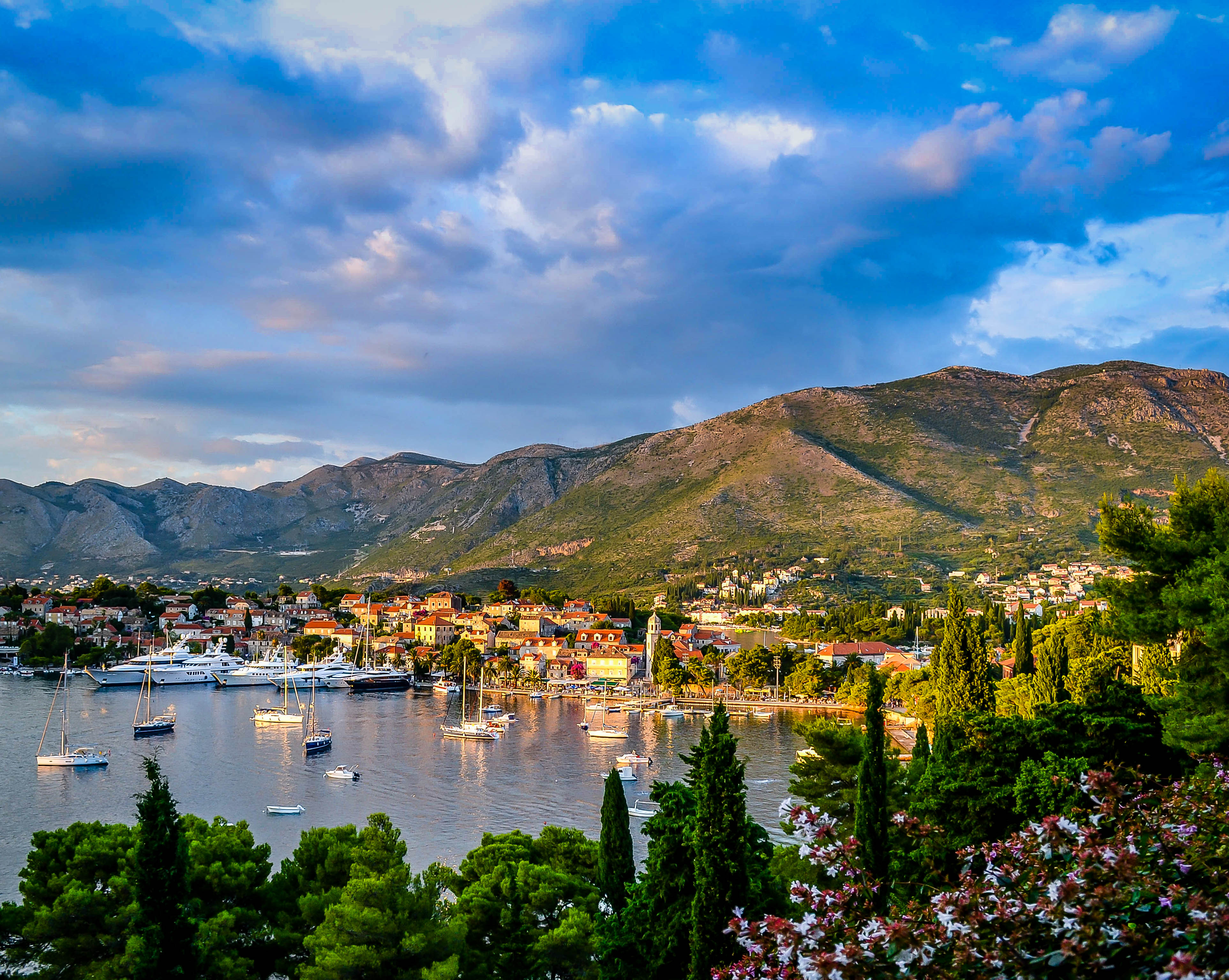
Croatia doesn't really have real estate agents or anything like Zillow. So we found an Airbnb in Cavtat in a newly constructed condo that was just about to be listed and moved in. After a week or two, we reached out to the owner and offered to buy it from him. He said yes.
That was August 2023. We'd accidentally built the model my parents had run my whole childhood. Half the year in America, half the year somewhere completely different. They'd picked the Bahamas. We'd picked Croatia. Same idea, different continent.
Living from Cavtat
The next two years, Cavtat became our base for everything. We used it as a launchpad to see the rest of the world. From Croatia we did the pyramids in Egypt, Antarctica on an expedition ship out of Ushuaia, Iceland, Malta, a three-week loop through Vietnam, Laos, Cambodia, and Thailand, road trips into Bosnia and Montenegro. We added 30+ countries to our list while keeping a real home, a familiar coffee shop, and a circle of friends we kept coming back to. By the end of it, we'd been to 65+ countries across all seven continents.
The Cavtat friendships mattered more than I expected. In a town of 2,000 people, we ended up meeting a group of locals who became some of the closest friends we've made anywhere. As foreigners in Croatia, you depend on people who know how things actually work, and they showed up for us in ways we'll be grateful for forever. Cavtat is still one of the most beautiful places I've ever been. It probably always will be.
But after a couple of epic summers, the gravitational pull of the place started to work against us. Everyone we knew wanted to come visit. We loved hosting, but we'd built the house to be our retreat, not a year-round bed-and-breakfast. By the end of 2025, we were ready for the next chapter.
Selling, in true Croatian fashion, was not straightforward. Our buyer was Australian. At closing, we found out the Croatian government was going to block the sale, because Australia had recently passed a law restricting foreigners from buying property there. Tit for tat. Luckily, the buyer's grandmother was Croatian. So before he could close, he first had to apply for Croatian citizenship through descent. The sale took months longer than expected, but it eventually went through.
The sale
All of this was happening while the company was quietly heading toward a sale of its own.
In July 2025, the board decided to test the market and we hired an investment banker to see if there was a deal to be done. There was.
It nearly wasn't. The deal went ninety-five days past the original close date, involved four law firms negotiating in real time, and got close enough to falling apart that I drafted a termination letter on a Saturday night in October. But in late October 2025, we sold Tatango to two private equity firms, Vocap and Edison Partners. On October 31st, we signed the papers and the wire hit. No earn-out. No contingencies. Cash up front.
Just like I'd planned back in 2022, the acquirer wanted nothing to do with me. My relationship with the company was over.
It's hard to describe what that felt like. For most of my adult life, the company occupied every minute of every day. Then I stepped aside but stayed on the board, still in the room. Then the sale closed and I had zero say in what happened next. Not even a heads-up about what the company was doing. After 18 years, just gone.
Cascais
When we started looking for what came next, Portugal was the obvious answer. We'd loved it in 2018, and now, with Croatia behind us and no real reason to be anywhere in particular, we had the chance to try again.
In early 2026, we landed in Cascais, just outside Lisbon. This time we rented. Owning a home in a foreign country sounds romantic until you've actually done it, and after Cavtat we'd learned the difference between a place you visit often and a place you own. Cascais sits next to Lisbon, one of Europe's better-connected hubs, which makes the rest of the continent easier to reach. Portugal is also far enough from Croatia in climate and culture that it feels like a fresh chapter rather than a repeat.
We're still figuring out whether it's a season or a longer stay. That's part of what makes it fun.
What's next
In November 2024, between the Cavtat summers, we bought a place in Denver. It was the first home we'd ever owned in America. We'd tried Seattle, Austin, Fort Lauderdale, and Tampa over the previous four years, looking for an American city that felt like home. Denver was the one. My sister, her husband, and their two kids lived in Castle Rock just south of the city, and being close to family for the first time in years was a big part of why we picked it. We'd ended up with the full version of my parents' model: one American base, one place abroad, and the rest of the world in rotation.
In mid-2026, the family gravity got stronger. Pulled by the same kids my sister was raising, my parents and even my 90-year-old grandparents moved from Florida to Colorado. They tell themselves they came to be closer to Jessica and me. We all know they came for the grandkids and great-grandkids. We don't hold it against them. Now we just have to work on getting Jessica's family out to Colorado too.
Beyond family, I've been figuring out the rest since the sale closed. Jessica and I are still traveling, aiming to hit 100 countries in the next few years. I'm staying fit. I've gone deep on autonomous vehicles, both as a study and as an investor, on a thesis that eventually no one will own a car. It'll all be Uber-like services. I'm watching AI closely. Humanoid robotics has my attention.
People ask if I have the itch to start another company. Every entrepreneur always has it. The healthy thing is to resist, stay disconnected for a while, and pay attention to what's actually happening in the world before deciding what's next.
In the meantime, I write essays for entrepreneurs going through what I've been through, and I help where I can.