
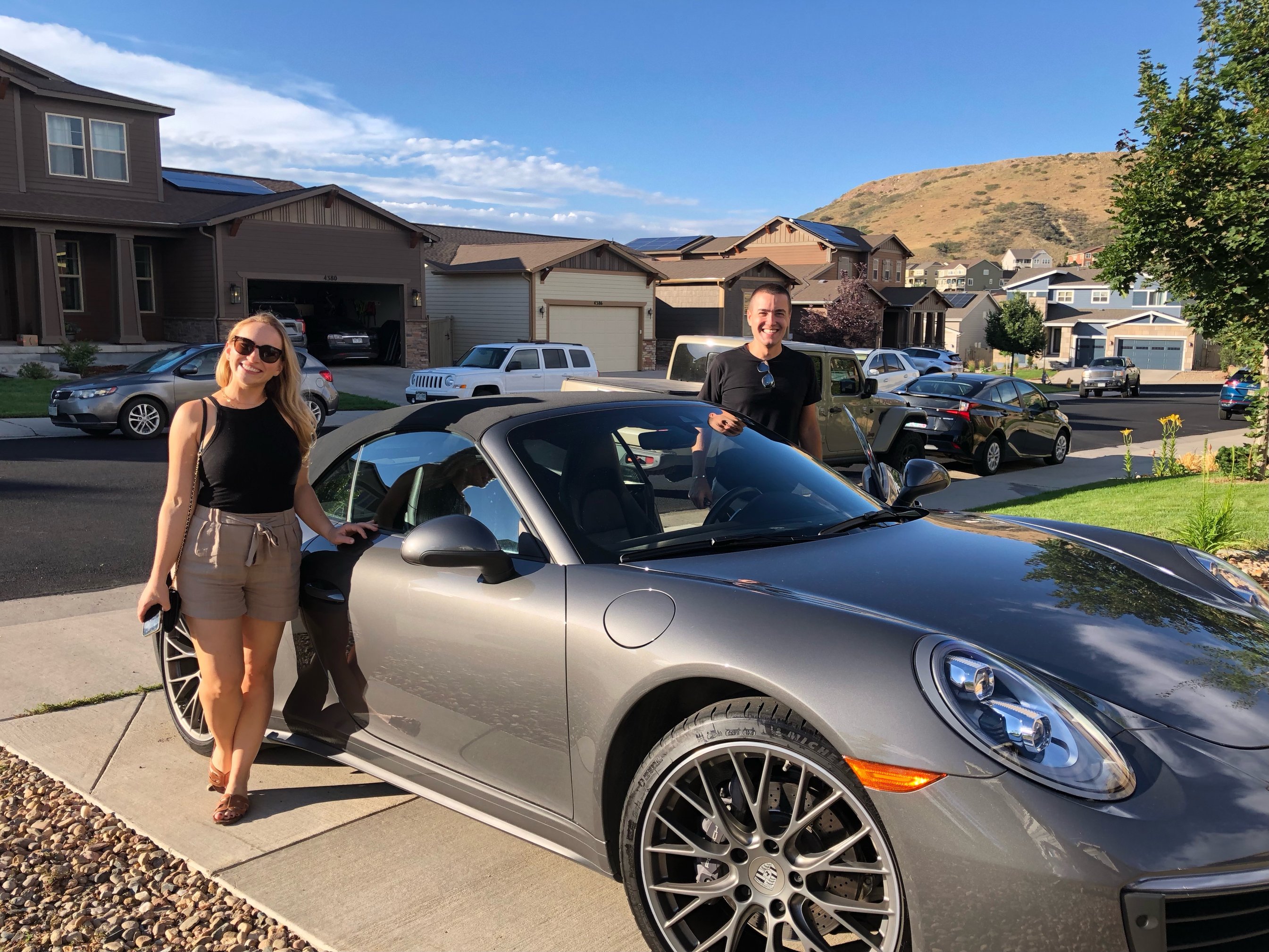
The salesman ran the numbers and told me the Porsche would be $2,000 a month.
I'd just made more than I'd ever seen in my bank account, all at once. $2,000 a month barely registered next to what had hit my account. In that moment, the payment didn't feel expensive at all.
That's exactly why I almost got it wrong.
When you come into money all at once, the monthly payment stops telling you the truth. It is built to make a big purchase feel small. After a financial windfall, that's a dangerous illusion.
The fix that saved us was simple: stop thinking in payments, and price everything at full cost against the whole pile, all at once.
Here's how I learned it.
Where the money came from
Over the 18 years I ran Tatango, we sold some of our shares a few times before we sold the company outright in October 2025. So our money arrived in a few big lumps, every couple of years, rather than building up steadily the way it does for most people. (I've also written about why we pay our taxes immediately and the lessons we learned chasing higher returns.)
If you've sold a home for a big profit, gotten a large bonus or an inheritance, had stock finally turn into real money, won the lottery, or landed a legal settlement, you came into money the same way we did. All at once. This is for you too.
The monthly payment lifestyle
Up until that first lump landed in 2020, we lived on monthly payments. And that made sense. Money came in monthly, money went out monthly, and the two lined up. The payment was the unit we thought in, because it matched how we actually lived.
Then you make a lot of money all at once, and the unit breaks.
$2,000 a month for the Porsche didn't feel like a decision. It felt like a yes. And it doesn't stop at the car.
The stack
One payment never feels like much. Neither does two.
A big mortgage? Doable. You just made a good amount of money.
Another car payment? Sure.
The ski boat you've always wanted? Why not.
Not one of those, on its own, looks extravagant. That's the trap. Each payment passes the test, because the test is rigged. We got lucky and started plotting these out before we bought any of them: every payment we were tempted by, stacked on top of each other. Even all of them combined still didn't look bad against the number we'd received.
Then we extrapolated. A few years of those payments running side by side, and the math turned ugly. Most of the money would be gone. Not because any single decision was crazy. Because every decision was made in the wrong unit.
Dave Ramsey
This is around when we found Dave Ramsey.
We didn't need the baby steps. We weren't digging out of debt. But I kept listening, and I kept hearing the same advice from Uncle Dave. He'd never let a caller judge a purchase by the monthly payment. He made them look at the full price and compare it to what they had saved. A sobering reality for most.
Something shifted in my head from that point.
The full price
We started looking at everything by the full purchase price instead of the payment. The car included.
My dream car was not $2,000 a month. My dream car was $121,878. Suddenly it wasn't a monthly payment anymore. It was a real chunk of what I'd worked 18 years to build.
That reframe changes the decision completely. At $2,000 a month, I could justify almost anything. At $121,878, I had to decide whether this one thing was really worth that much money leaving the account all at once.
Same car. Same money. The only thing that changed was the unit, and the unit was the whole game.
We ran every big purchase through that filter after that. The house. The Europe home. All of it. Suddenly each one became a real decision again, because the number felt real again.
I still bought the Porsche. I just bought it with a realistic frame of reference instead of a rigged one.
The sticker is only the start
$121,878 was not the cost of the Porsche. It was the entry fee.
A car like that needs special servicing (an annual service can run you over $1,000). It has to be hand washed. The insurance is ridiculous. Curb a wheel and ouch. None of that shows up on the sticker, and all of it shows up every month for as long as you own the thing.
Same goes for the boat and the second home. They all come with their own monthly payments, except these never end and you don't get to choose the amount.
So when you run a purchase at full price, run the upkeep too. What does it cost to own this every month after I own it?
I would rather pay once upfront and carry a small operations budget for maintenance than stack a monthly payment on top of more monthly payments. One of those you can see the bottom of. The other just keeps growing.
Counter argument
I know people who made a lot of money and put all of their purchases on payments, claiming they're getting one over on the bank, making the spread between the loan and what their investments earn. So this isn't the only way to do it, and I won't pretend it is.
But I'll tell you what I've noticed, and this is just anecdotal. The people I know playing this game, stacking payment on payment while claiming to work the arbitrage, end up with huge monthly payments spread across a ton of purchases. They seem to carry more financial stress than we do, not less.
Kill the monthly payment
If you come into money all at once, kill the monthly payment.
Add up the full price before you buy anything. Look at the whole number, against the whole pile, all at once. Let it feel like the decision it actually is.
The payment is built to make expensive decisions feel manageable. That's what makes it dangerous.
Take it for what it's worth.