
[]()
The last couple weeks I’ve been building a web app I’ve always wanted to exist. I have no technical background, and I’m honestly shocked by how good AI coding has become.
Before this, if you had an idea for a website or app, you needed engineers, designers, time, and money. It would take months just to get something usable. Now, using tools like [Replit](), you can build a real product in a night and have something live by the end of a weekend.
What’s even harder to process is the economics of it.
The coding agent I’m using is effectively doing the work of multiple six-figure engineers, and it’s costing me roughly $18 an hour.
Then I connected it to Claude _[(using Claude Cowork)]()_ , and that’s when it stopped feeling like software and started feeling like a system.
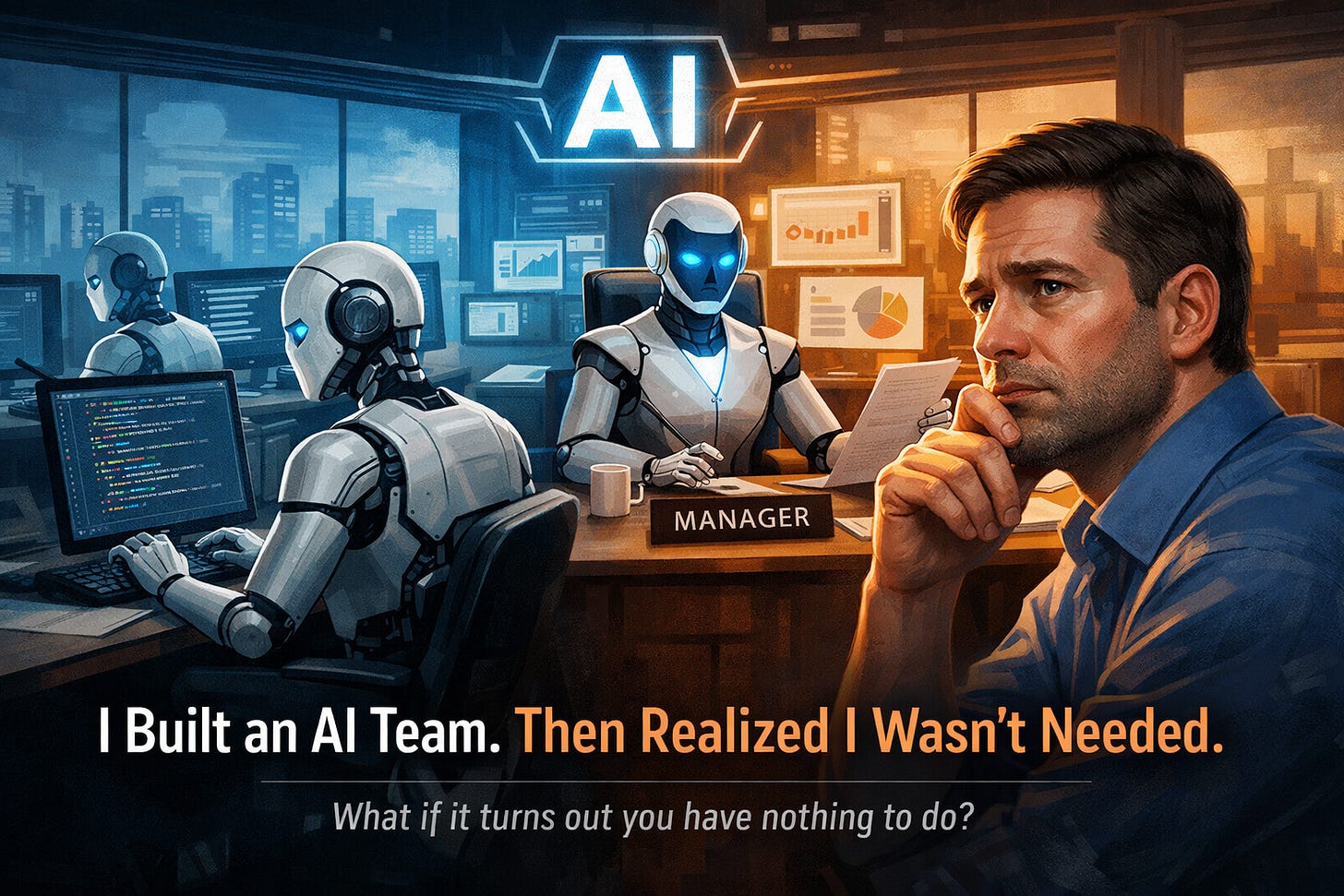
I had one very specialized system writing the code. Then I added another system on top of it that could plan, direct, and review the work. The simplest way to explain it is that I had one robot doing the work, and another, more general robot telling it what to do, when to do it, and checking that it was working.
That second layer, the “manager,” costs about $99 a month. It’s replacing what would normally be a six-figure role.
I wasn’t writing code, and I wasn’t really managing anything either. I gave it a single instruction to run a full SEO audit, come up with ways to increase traffic, and implement the changes. Then I left.
A few hours later I came back, and it was done. Not partially done or in progress, just done. It felt exactly like leaving an office and coming back to a team that had made progress without you. Except there was no team, just software.
That’s when it started to feel different. If the system can do the work and manage the work, it raises an uncomfortable question about what role is left for the person in the middle. Right now I’m still initiating things and paying for it, but that feels like a temporary layer.
At the same time, companies like Anthropic are already working on more capable systems. The pace of improvement doesn’t feel linear, it feels like step changes every few months. I notice it personally, what felt impressive yesterday already feels outdated today, and the gap seems to be widening, not closing.
What’s been bothering me more than the technology itself is how differently people are reacting to it.
I’ll tell friends what I’m seeing, and a lot of them respond the same way. They’ll say they’ll check it out when they have some free time, or that AI can’t replace real creativity, or that they tried it once earlier this year and it wasn’t very good, so it must be overhyped.
There’s a kind of quiet dismissal, like this is interesting but not urgent. You know who you are.
At the same time, there’s another group forming that’s reacting very differently. They can’t stop thinking about this. They’re experimenting constantly, staying up late, and trying to understand how far this goes and what it changes. Conversations with them feel completely different, like they’ve already accepted that something fundamental is shifting.
The gap between those two groups feels like it’s going to matter.
This is incredible if you’re a builder. If you have ideas, this might be the best time in history to act on them. But for a lot of people, this is going to be a difficult transition.
If your job today happens inside a browser or on a computer, or you manage people who do, you should be paying attention. Not casually, but seriously.
Because from what I’m seeing, those exact tasks are already being done by systems that are getting faster and better at a pace that’s hard to keep up with.
And yet, most people are still going about their lives like nothing is changing. It has a familiar feeling, like early 2020, when a small group of people understood what was coming and most didn’t. Everything looked normal, right up until it wasn’t.
I might be wrong about where this goes. But if I’m not, the people who start adapting now will be in a very different position than the ones who wait.
So what does “adapting” actually look like?
It’s not reading about this. It’s not waiting. It’s not casually trying it once.
It’s using it.
Start building something. It doesn’t have to be big or important. Build anything. The goal isn’t the outcome, it’s learning how these systems actually work.
Use [Replit]() to build that website you’ve always thought about. Build a small app that solves a problem at work, at home, or even something simple for your kid’s team or a local group. You’ll learn more in a weekend doing that than you will in months of reading.
Then start using [Claude]() like a coworker, not a tool.
Give it real tasks. Things you’ve been putting off.
Let it handle something end to end. A dispute with a company. Research you don’t have time for. Writing something you’ve been avoiding. Planning something that would normally take you hours.
Then take it one step further.
Start asking: what in my life could this replace or take over?
Have it help plan your kid’s birthday party instead of defaulting to a planner.
Have it build a structured financial plan before you ever talk to an advisor.
Have it draft emails, proposals, or decisions you’d normally outsource.
You don’t have to fully replace anything overnight.
But you should start testing the edges.
Because once you see it handle real responsibility, not just small tasks, something shifts.
You stop thinking of this as a tool.
You start seeing it as a substitute for entire categories of work.
And the people who learn how to do that early are going to have a massive advantage over the people who don’t.
Thanks for reading Student of the Game! Subscribe for free to receive new posts and support my work.
Subscribe