
My business partner (Matt) and I each put in $2,500 (a lot of money for us at the time—we were both in college) to start the company, each getting 50% equity. The original formation document is below.
[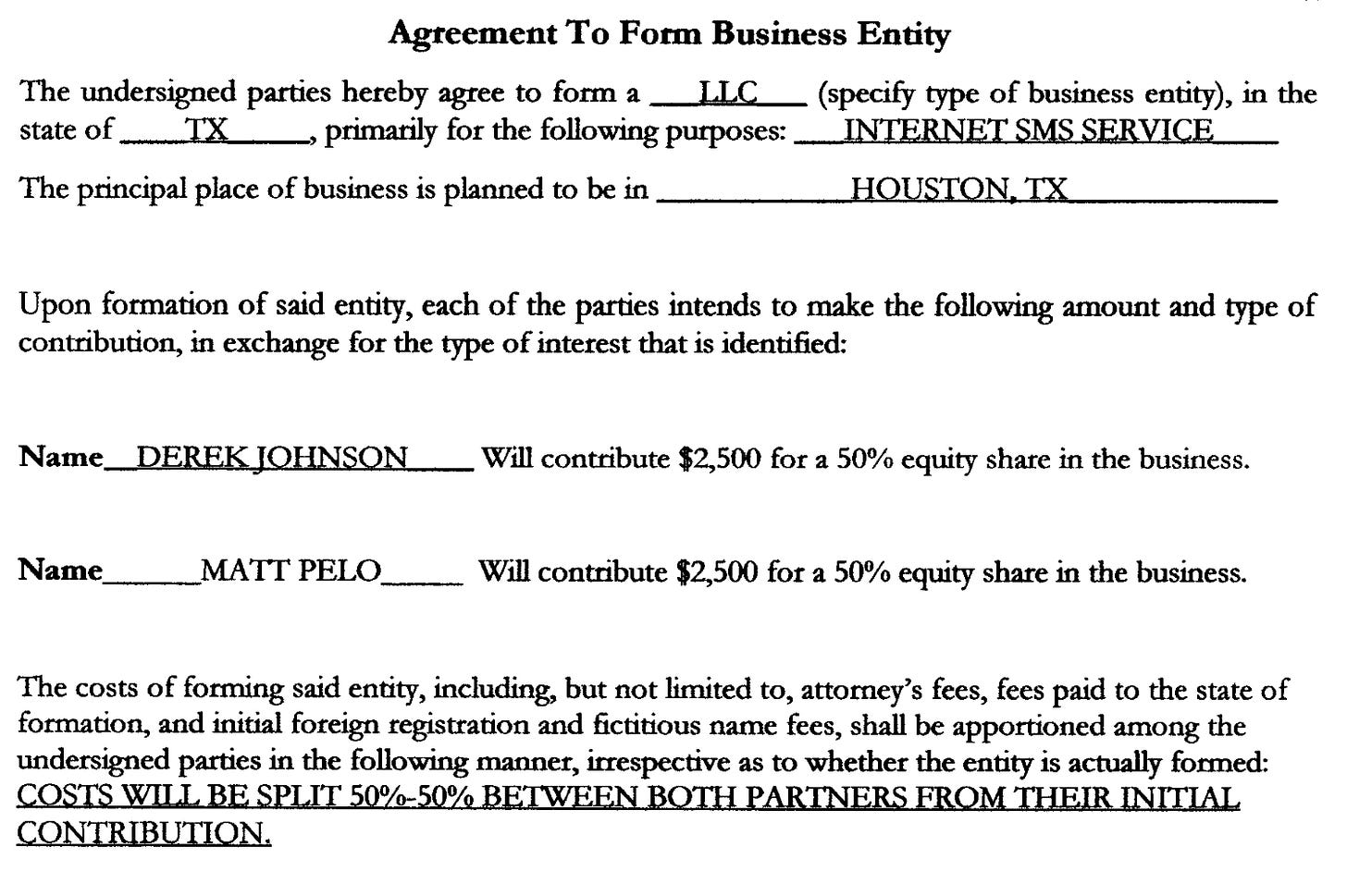]()
My unspoken assumption (and here’s the first lesson: never have an unspoken assumption in business—write things down, agree on them, sign them) was that our 50% equity wasn’t just for the $2,500. It was for the money **and** the long-term commitment: working on the idea for the foreseeable future, dropping out of college (which we both did), working for little to no pay in the early days, and sacrificing most everything else for the company.
Eight months in, Matt decided he didn’t want to continue and re-enrolled in college. That’s when it became clear we had been operating under completely different definitions of our deal. I thought the equity represented both the money and the time/sacrifice/opportunity cost. He thought it was simply a straight trade—$2,500 for 50% equity—regardless of future involvement.
So, while he left me with 100% of the responsibility to run and grow the company, he kept his 50% ownership. To him, this felt fair. To me, it felt like a complete betrayal of our “original agreement.”
Luckily, our operating agreement had clause 7.5, which stated that if a Manager or Officer stopped carrying out his duties, that would trigger an immediate option for the company to buy back his interest at the value of the last funding round ($250,000). Payments could be made over fifteen equal annual installments at 6% interest. In the end, we owed Matt $152,344 plus accrued interest.
It took us over 11 years to pay off that note, and because we fell behind on payments, the interest rate jumped from 6% to 12%. That extra interest cost us over $100,000 over the years.
**Lesson Learned:** We could have avoided all of this by vesting all—or at least a portion—of our founder shares. For example, we could have given ourselves 5% equity each for the $2,500 investment, and vested the remaining 45% over 4–5 years. Vesting means the equity is technically yours, but you earn it over time.
In that scenario, when Matt left after eight months, he would have kept his 5% plus a small portion of the vested shares—maybe ending up with around 6% total—rather than the 50% he actually left with. I could have lived with 6% for someone who hadn’t contributed in 15 years. But 50%? That was a deal breaker.
This is a very simplified explanation of founder vesting and doesn’t get into specifics like vesting schedules, cliffs, or acceleration clauses. Always consult your attorney when setting this up. You can learn more about founder vesting here: