
I want to do something a little different today.
A few years ago, a guy I'd never met changed my life. His name is Barrett Ersek, and I heard him speak at an Entrepreneurs Organization conference in Seattle back in 2016. I walked into that room believing what most people believe — that doing something big in business mostly comes down to luck. Right idea, right time, keep grinding and maybe you trip over it someday.
I walked out understanding that disruption isn't luck at all. It's a pattern. A repeatable one. And once Barrett showed me the mechanics behind it, I couldn't unsee it — in every business I studied, every line out the door, every company that came out of nowhere and flipped an entire industry.
That one talk eventually became a whole book.
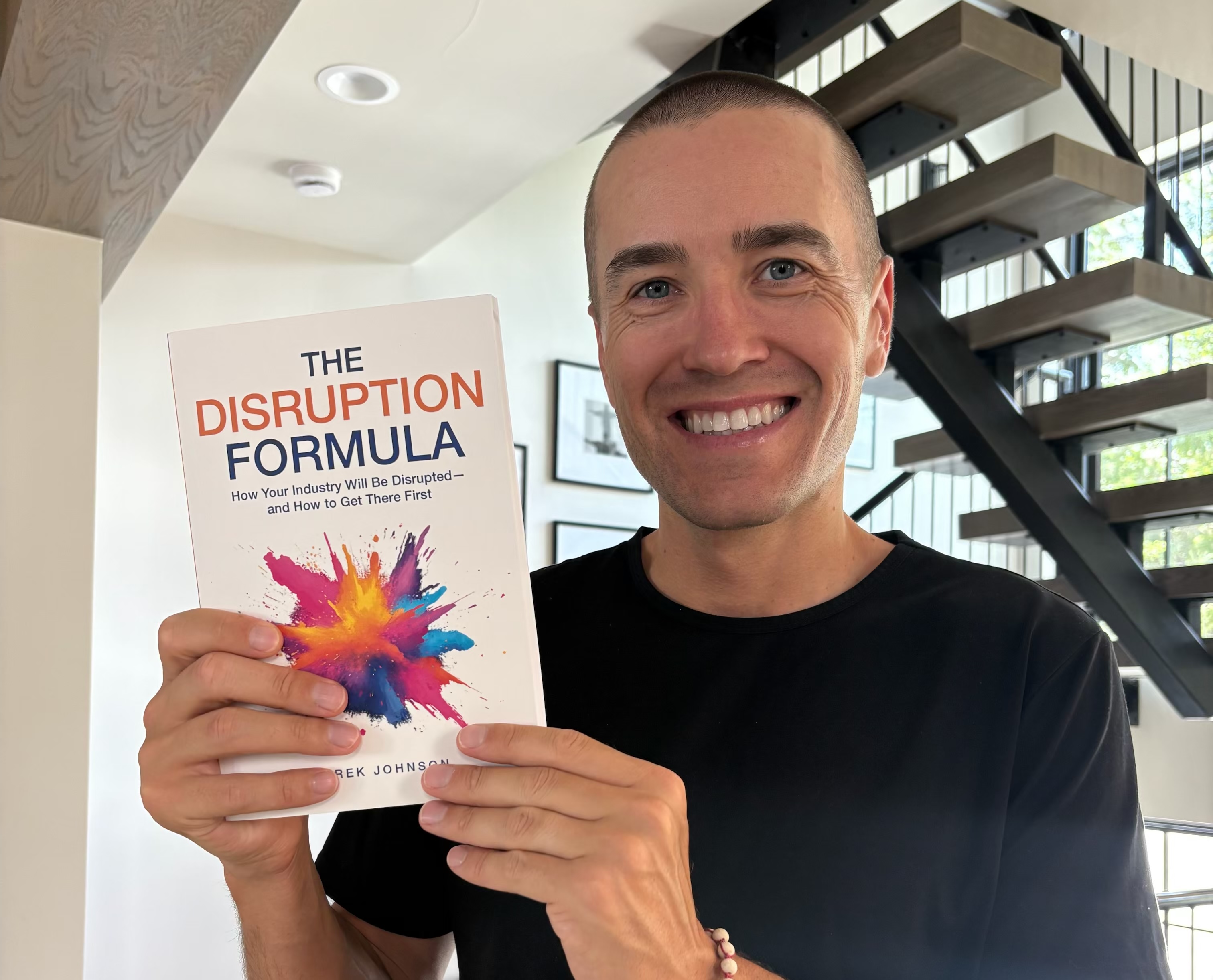
Here's the thing I've noticed since: almost everyone who reads just the introduction ends up wanting to read the rest. And I don't think that's because I'm some brilliant writer. It's because Barrett's story is genuinely that good — and because the moment you see the formula laid out, your brain starts running it against your own business automatically. You can't help it.
So I'm not going to tease it or paywall it. I'm just going to give you the introduction. The whole thing. Free, right here.
My one ask: don't just read it and nod. Barrett didn't. He heard one idea, stood up in the middle of a class, walked out, and drove home to go build it. That's the difference between people who find this stuff interesting and people whose lives it actually changes. Take the methodology and do something with it.
Here it is, unedited.
Disruption Isn't Luck. It's a Formula.
As a business owner without a college degree, I used to think that my best chance to do something big in business would come down to luck. I figured that if I kept working hard and stayed in the game long enough, maybe someday I'd stumble into the right idea at the right time.
That belief held until October 2016, when I attended a business conference in Seattle hosted by the Entrepreneurs Organization (EO). That's where I first heard Barrett Ersek tell the story that would change the way I understood the mechanics of disruption forever.
Barrett wasn't a Silicon Valley tech founder or a venture-backed wunderkind. He was a guy who started in lawn care. In 1989, while still in high school, he started Custom Care Lawn Service.
At first, he planned to run the business part-time while attending college. But when his high school sweetheart became pregnant, Barrett left college, got married, and went all in on building the business to support his new family. By 1994, he had grown Custom Care into a $2 million-a-year operation with about 20 employees. But growth stalled. For the next few years, he couldn't break through that ceiling.
In 1998, Barrett enrolled in a three-year program at MIT hosted by EO. The program consisted of five-day sessions each year, and it was during his second year that he met Verne Harnish — renowned entrepreneur, business coach, and author of Scaling Up, Mastering the Rockefeller Habits, and The Greatest Business Decisions of All Time. Verne introduced Barrett to a simple but radical concept: that true disruption doesn't require invention — it comes from delivering a 10X improvement over the industry standard. That idea became the foundation of what we now call the Disruption Formula.
That idea hit Barrett hard. He didn't just want to grow his business — he wanted to disrupt the entire lawn care industry. But how?
At the time, one of the biggest barriers in lawn care wasn't the service itself — it was the process of quoting. Getting an accurate estimate for lawn treatment was frustratingly slow. Homeowners would call for a quote, and Barrett's team would have to drive out, measure the property in person, and then deliver a quote — often three weeks later. By that point, the customer had moved on or lost interest. Only about 20% of inquiries converted to sales. The whole thing was expensive, inefficient, and slow.
Barrett realized that if he could reduce the time it took to get a quote — not by 10%, but by 10 times (what we'll refer to as 10X) — he would gain a massive competitive advantage over others in the industry. Instead of a three-week turnaround, what if he could deliver a quote instantly? That shift wouldn't just improve the customer experience; it would completely disrupt the entire lawn care industry.
He started asking other business owners at the program how he might achieve this lofty goal. One conversation proved pivotal. Barrett spoke with the CEO of a web platform that had developed a new tax assessment tool for the city of Newton, Massachusetts. This tool used tax maps combined with aerial photography to let cities assess property values remotely — without needing a tax assessor to physically visit each property.
That was the moment the lightbulb went off.
Barrett realized he could use the same approach — but instead of assessing taxes, he'd use aerial photos and tax maps to measure lawns remotely. With that, he could deliver a quote to the customer immediately, without ever setting foot on their property.
The idea was so clear and compelling that Barrett stood up in the middle of the class, politely excused himself, walked out, jumped in his car, and drove straight back to Philadelphia to implement his new innovation.
When he returned to his office, he pitched the idea to his team — but they shut it down. Every single one of them told him it wouldn't work. On top of that internal resistance, Barrett estimated it would cost $500,000 to build the technology needed to deliver instant quotes to customers. This was in 1998 — well before Google Maps.
Faced with a team that wouldn't buy into his new idea and a hefty upfront investment, Barrett made a bold decision: he sold the company. TruGreen, a division of Scotts Miracle-Gro, acquired it.
With time, capital, and a clean slate, Barrett built the software he envisioned to deliver instant quotes to customers. He assembled a new team who believed in the mission and launched a new company — Happy Lawn of America — on January 1, 2004.
On day one, the weather struck: feet of snow on the ground, six degrees outside. Every other lawn care company was frozen out — literally. They couldn't visit the homeowner's property, and even if they could, the snow made it impossible to tell what was grass and what wasn't.
But not Barrett. His team didn't need to visit properties. They could quote instantly over the phone, from the warmth of their office. This wasn't just faster — it was transformative.
Instead of taking three weeks to deliver a quote, Barrett's new system could provide a potential customer a quote instantly. As a result, conversion rates jumped from 20% to 80%, completely changing the economics of his business and giving him a serious edge in acquiring new customers.
Remember how Barrett's first business took six years to reach $2 million in revenue? Happy Lawn, with its ability to deliver instant quotes over the phone — and drastically improve sales conversions — hit $2 million in just the first seven months. And it didn't stop there: $3 million by the end of year one, $5 million in year two, $8 million in year three, $10 million in year four, $13 million in year five, and $16 million in year six.
By then, with 100 employees, a regional footprint, and a powerful growth trajectory, ServiceMaster — the dominant incumbent in the industry — acquired Happy Lawn.
That story stuck with me. Barrett didn't invent a better lawn treatment or a new fertilizer. He found a broken part of the customer experience — the wait time to get a quote — and made it exponentially faster. That was his advantage.
And the more I thought about it, the more I realized: this wasn't just a one-off. It was a formula. A repeatable framework for building a business that doesn't just compete — but dominates.
With Barrett's permission, I've evolved that framework into a formula — and ultimately, into the very book you're reading now. I'm deeply grateful for the spark he created, for the generosity he showed in sharing it, and for EO, for hosting speakers like him.
I've spent the last seven years sharing that formula with other entrepreneurs. Watching them use it to shift their thinking, find their advantage, and dominate their industries. That's why I wrote this book.
Because disruption doesn't wait. And it's not luck — it's pattern recognition.
The pattern is simple: disruption is caused by making a product or service 10X cheaper, faster, or better.
That's the formula. And this book will show you how to use it.
Want Proof It Works?
Once you have the lens, you start seeing the same move everywhere. Here's a taste of the companies I break down later in the book — every one of them took a single part of the experience and made it dramatically cheaper, faster, or better:
Robinhood — stock trades from $10 to $0
Ford (Model T) — a car from $2,000 to $260
Dell — a PC from $3,000 to under $800
Wise — transfer fees from 5% to ~1%
Vanguard — fund fees from 2.00% to 0.07%
Dollar Shave Club — shaving from $20/month to $3
Warby Parker — glasses from $300 to $95
Redbox — rentals from $5 to $1
WhatsApp — international messaging to free
iTunes — a $15 album to $0.99 a song
Happy Lawn — a lawn quote from 3 weeks to 10 minutes
Lemonade — an insurance claim from 30 days to 3 seconds
Little Caesars — pizza pickup from 25 minutes to zero
SpaceX — a launch from $150M to ~$60M
Halo Top — a pint of ice cream from 1,000 calories to 280
These aren't edge cases. They're proof that the formula works — again and again.
That's the introduction.
If Barrett's story landed on you the way it landed on me, the rest of the book is the how — how to map your own industry, find the one broken step everyone's accepted as normal, and turn it into a 10X advantage. It's the same framework, broken into a step-by-step process, with 25+ full case studies showing exactly how real companies pulled it off.
I'll be straight with you: this didn't just change how I run businesses. It changed the trajectory of my career and, honestly, my life. And I genuinely believe it can do the same for yours — but only if you treat it like Barrett did. Not as something interesting to read. As something to go build.
So read it. Then go find your industry's three-week lawn quote — and make it instant.